
Understanding how ketosis works for weight loss explained can feel confusing at first, especially if you are new to low-carb diets. But once you break it down into simple ideas, it becomes surprisingly easy to follow. In fact, many people who struggled with stubborn fat loss finally saw results when they understood how their body actually uses fuel.

In this article, you’ll learn everything in a simple, human-friendly way—no complicated science jargon, just real explanations, step-by-step guidance, and practical tips you can actually use.
What is ketosis and keto diet (ketosis, keto diet, low carb diet)
Before we understand how ketosis works for weight loss explained, we need to start with the basics.
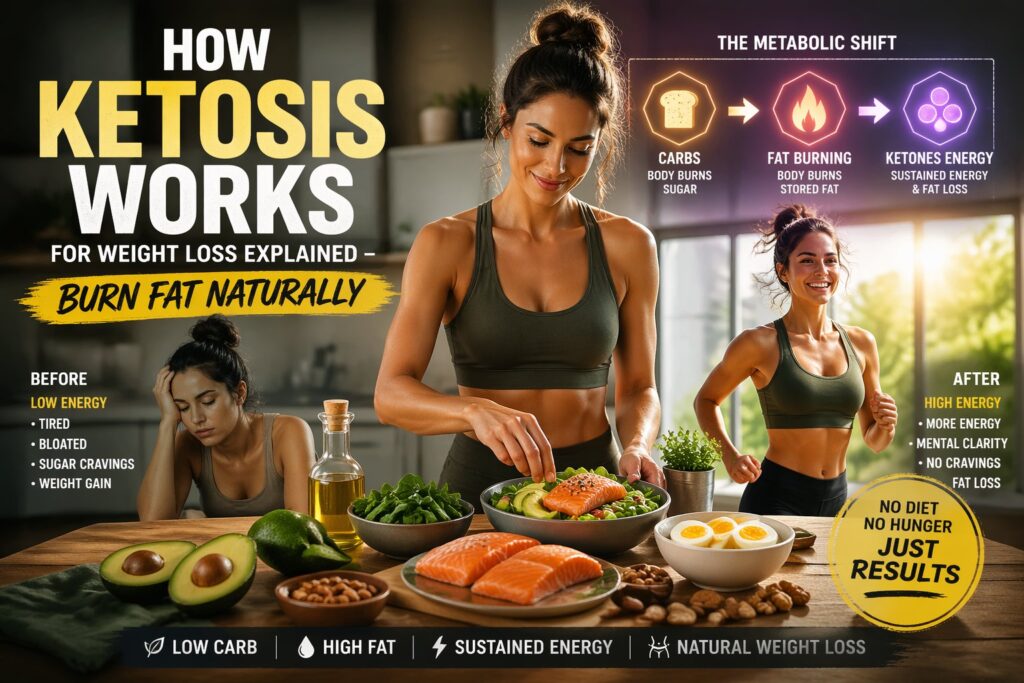
Ketosis is a natural metabolic state where your body shifts from using carbohydrates (sugar/glucose) as its main energy source to using fat instead. This happens when you reduce your carb intake significantly and follow a keto diet or low carb diet.
Normally, your body loves glucose because it is quick energy. But when carbs are not available, your body gets smart—it starts breaking down stored fat into molecules called ketones, which become your new fuel.
Think of it like this:
- Normal diet = Car engine running on petrol (carbs)
- Keto diet = Engine switching to electric mode (fat)
This switch is what makes ketosis so powerful for fat loss.
Many people don’t realize that their daily sugar intake keeps their body locked in fat storage mode. But once carbs drop, the body is forced to “unlock” stored fat and burn it for energy.
How ketosis works for weight loss explained (fat burning, metabolic state, ketones)
Now let’s dive deep into how ketosis works for weight loss explained in the simplest way possible.
When you eat fewer carbs, your blood sugar levels drop. As a result, insulin levels also decrease. Since insulin is the hormone responsible for storing fat, lower insulin means your body finally gets permission to access stored fat.
Here’s what happens step-by-step:
- You reduce carbs drastically
- Your glycogen (stored sugar) gets used up
- Your body looks for a new fuel source
- It starts breaking fat into ketones
- Your body enters a fat-burning metabolic state
This is where the magic happens.
Instead of constantly burning sugar from meals, your body becomes a fat-burning machine. Even your stored belly fat starts getting used for energy.
A simple way to understand it:
- Carbs = quick fuel (but short-lasting)
- Fat = slow-burning fuel (long-lasting energy)
That’s why many people in ketosis report steady energy, fewer cravings, and noticeable weight loss over time.
Step-by-step guide to enter ketosis for fat burning (fat burning, metabolic state, ketones)
If you’re wondering how to actually get into this fat-burning state, here’s a simple step-by-step guide.
Step 1: Cut down carbs
Reduce your daily carbs to around 20–50 grams. This forces your body to start switching fuel sources.
Step 2: Increase healthy fats
Eat foods like:
- Avocados
- Eggs
- Nuts
- Olive oil
- Fatty fish
These help your body adjust to fat as fuel.
Step 3: Moderate protein intake
Don’t overeat protein. Too much protein can convert into glucose, slowing ketosis.
Step 4: Stay hydrated
Water and electrolytes are important. Many people feel tired in the beginning due to water loss.
Step 5: Wait for adaptation
It usually takes 2–7 days to enter ketosis fully. This phase is called “keto adaptation.”
During this time, your body is learning to efficiently use ketones instead of glucose.
Many beginners feel low energy at first, but this is temporary. Once adapted, energy levels often become more stable than before.
What happens in your body during ketosis (fat adaptation, ketones energy, glucose)
To truly understand how ketosis works for weight loss explained, you need to see what’s happening inside your body.
When carbs are restricted:
1. Glycogen stores empty
Your body uses up stored sugar (glycogen) in the liver and muscles.
2. Fat breakdown begins
Fat cells release fatty acids into the bloodstream.
3. Ketones are produced
Your liver converts fat into ketones, which become your main energy source.
4. Brain switches fuel
Even your brain starts using ketones instead of glucose.
This process is called fat adaptation, and it is the key reason why ketosis is effective for long-term fat loss.
One interesting thing many people notice is mental clarity. Some describe it as “fog lifting” from their brain once they are fully in ketosis.
Foods to eat and avoid on ketogenic diet (keto diet foods, carbs restriction)
Food choices play a huge role in maintaining ketosis and supporting weight loss.
Foods to eat:
- Meat (chicken, beef, lamb)
- Eggs
- Cheese
- Avocados
- Leafy greens
- Nuts and seeds
- Coconut oil and olive oil
Foods to avoid:
- Sugar and sweets
- Bread and pasta
- Rice
- Potatoes
- Soft drinks
- Most processed foods
This carbs restriction is what keeps your body in a fat-burning state.
Many beginners struggle here because hidden carbs are everywhere—sauces, snacks, and even “healthy” packaged foods.
So reading labels becomes extremely important.
Common mistakes that stop weight loss in ketosis (plateau, hidden carbs)
Even though ketosis is powerful, people still make mistakes that slow down results.
1. Eating too many hidden carbs
Even small amounts can kick you out of ketosis without noticing.
2. Overeating calories
Ketosis helps burn fat, but eating excess calories can still slow progress.
3. Not drinking enough water
Dehydration can cause fatigue and slow metabolism.
4. Ignoring electrolytes
Low sodium, magnesium, or potassium can cause “keto flu.”
5. Expecting instant results
Weight loss takes time. Early weight loss is often water weight, not fat loss.
If you hit a plateau, don’t panic. It usually means your body is adjusting, not failing.
Real-life example and simple anecdote (fat burning journey, ketosis lifestyle)
Let’s make this more real.
A friend of mine, Ali, struggled with belly fat for years. He tried different diets, but nothing worked long-term. He would lose weight quickly, then gain it back even faster.
When he started learning how ketosis works for weight loss explained, everything changed.
At first, he found it difficult to avoid rice and bread—especially in a typical South Asian household. But after one week, something surprising happened:
- His cravings dropped
- His energy became stable
- He stopped feeling hungry all the time
By the third week, he noticed his waistline shrinking.
The most interesting part? He said he no longer felt “controlled by food.” Instead, he felt in control of his eating habits for the first time.
This is not magic—it’s simply your body switching fuel systems.
Benefits of ketosis beyond weight loss (energy, focus, appetite control)
While weight loss is the main goal, ketosis also offers other benefits:
- Better appetite control
- Reduced sugar cravings
- More stable energy levels
- Improved mental focus
- Less frequent hunger spikes
These benefits make it easier to stick to a healthy lifestyle without constant dieting stress.
Final thoughts on how ketosis works for weight loss explained
Now you clearly understand how ketosis works for weight loss explained in a simple, practical way.
It all comes down to one powerful shift: your body switching from burning sugar to burning fat.
Instead of depending on constant carbs for energy, your body learns to use stored fat efficiently. This is what makes the ketogenic approach so effective for many people.
However, success depends on consistency, patience, and smart food choices. It’s not an overnight transformation—but when done correctly, it can completely change how your body uses energy.
If you stay consistent, avoid common mistakes, and give your body time to adapt, ketosis can become a powerful tool for sustainable fat loss and better overall health.